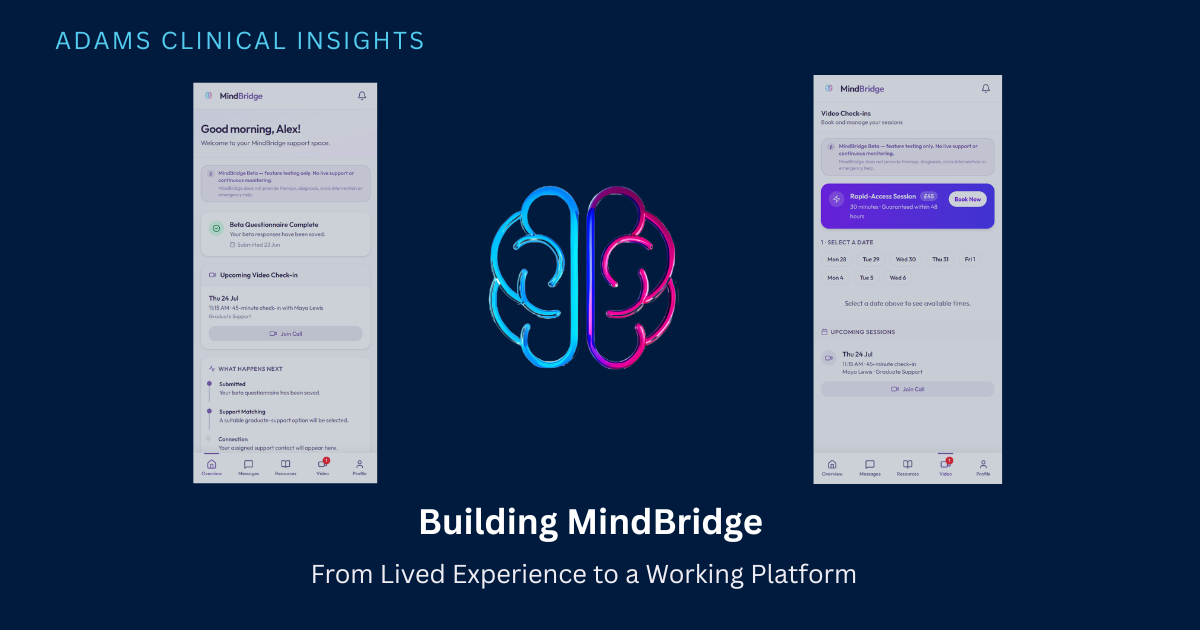
MindBridge did not begin with a pitch deck, a development team or a large investment. It began with two unresolved problems: what happens to people while they are waiting for meaningful mental health support, and what happens to psychology graduates when they leave university and try to find a meaningful way into the profession.
Adams Clinical was founded in December 2025, but the experiences that shaped it began years earlier.
The founder behind the company had first sought help for anxiety in 2017. What followed was a pattern that will be familiar to many people navigating mental health support in the UK: contact with primary care, medication, referrals and conversations with different support services, but no sustained relationship with a psychologist or psychiatrist.
Almost a decade later, that experience remains part of the reason MindBridge exists.
This is not a criticism of the individuals working within the NHS, charities or community services. Many are operating under enormous pressure. It is about the space that can exist between asking for help and receiving the right help.
And that space can feel very long when you are the person living inside it.
The service existed. Access to it did not.
A personal experience — but not an isolated one
The scale of poor mental health in the UK makes this much larger than one founder's experience.
Research published by the Mental Health Foundation in 2026 found that around one in four UK adults — approximately 14 million people — were experiencing poor mental health in its most recent data.[1]
The same research found a striking relationship between financial circumstances and mental health. Among people who described themselves as financially struggling, 54% experienced poor mental health, compared with 17% of those who were financially comfortable.[1]
Separate analysis from the Health Foundation found that 63% of people in problem debt reported medium or high anxiety, compared with 41% of people who were not in problem debt.[2]
For people already struggling financially, private care is not always a realistic escape route.
That was part of the founder's own experience. At a point when consistent support felt desperately needed, commercial online therapy appeared to offer something much closer to what was being sought: regular access to another human being rather than another disconnected conversation.
But the cost was around £150 a month at the time.
For someone struggling with work and relying partly on state support, it might as well have been £1,500.
The service existed.
Access to it did not.
The gap between referral and care
There are national standards intended to reduce waits for NHS Talking Therapies. NHS England states that 75% of patients should receive a first appointment within six weeks of referral and 95% within 18 weeks.[3]
The NHS Talking Therapies manual also makes an important distinction: the first appointment is primarily an assessment, and from a patient's perspective the time between referral and the second session can be particularly significant because that is effectively when treatment begins.[3]
MindBridge was conceived around that gap.
Not as a replacement for NHS treatment.
Not as a replacement for psychologists, psychiatrists or other regulated clinical services.
But as a structured human bridge for people who have asked for help and may still have a period of uncertainty ahead of them.
That principle eventually became central to the design of MindBridge — and particularly to the planned Access tier, intended to keep structured support within reach of people receiving Universal Credit, PIP or other qualifying benefits.
The thinking was simple: the people under the greatest financial pressure should not automatically be the people with the fewest options for human support.
A second problem appeared after university
There was another experience shaping Adams Clinical at the same time.
Around a year before the company was founded, its founder graduated with a bachelor's degree in criminal psychology, initially intending to continue towards forensic psychology.
Graduation brought a different kind of uncertainty.
Psychology attracts large numbers of graduates, but finding the experience needed to move towards further professional training can be difficult. Relevant opportunities can be fiercely competitive, and early-career graduates can find themselves trying to gain meaningful experience while also needing to earn a living.
The two problems began to connect.
On one side were people who wanted more consistent, affordable human support.
On the other were psychology graduates who wanted structured experience, supervision and an opportunity to apply what they had learned within appropriate boundaries.
That intersection became the foundation of Adams Clinical and MindBridge.
Then came the question: how do you actually build it?
Having an idea and building a functioning digital platform are very different things.
There was no software-development background behind MindBridge.
Initially, the assumption was that the technology would simply have to be outsourced.
Over a series of roughly eight video meetings, development companies and agencies in the UK, Europe and the United States were approached about building the platform.
The quotes routinely landed somewhere around the £10,000–£20,000 equivalent range.
For an early-stage company without significant investment, that wasn't viable.
Attempts were made to find technical collaborators. Funding applications did not always succeed. Potential routes towards a technical co-founder did not materialise.
Ironically, however, repeatedly explaining MindBridge to developers created something useful.
Every conversation forced the product to become clearer.
Features had to be described.
User journeys had to be mapped.
Requirements had to be written down.
What started as conversations with companies that might build MindBridge gradually became a technical requirements document.
Then came an attempt to reduce that document into the smallest possible MVP.
And another realisation followed:
Reducing the product until it was affordable also risked removing the things that made it worth building.
So another option emerged.
Learn.
Building in small pieces
The internet has changed what it means to build technology without being a traditional software engineer.
Tools such as Replit made it possible to work alongside AI-assisted development while still remaining directly involved in the architecture, decisions, testing and refinement of the product.
MindBridge began to grow in very small pieces.
Not through an overnight prompt asking artificial intelligence to produce an entire mental health platform, but through individual problems:
Build this screen.
Understand why this route doesn't work.
Create this database relationship.
Test this user journey.
Break it.
Fix it.
Move to the next thing.
Some evenings involved two or three hours after finishing a normal working day. Other periods involved considerably larger pieces of development, such as messaging, scheduling or the systems that sit behind the member experience.
Over time, something unexpected happened.
The person who began the process believing they were incapable of building software became increasingly able to read it, question it, test it and understand what it was doing.
There were plenty of moments when the project felt out of its depth.
There still are.
Imposter syndrome does not disappear simply because a build succeeds.
But there is something difficult to replicate about spending hours working through a problem and then refreshing a screen to find that something which previously existed only as an idea now actually works.
Approaching beta
MindBridge is now approaching its first controlled beta.
It is not finished — and in many ways it probably never will be.
Digital products evolve. More importantly, services involving real people should evolve when those people tell you what works and what does not.
The beta is therefore not simply about finding technical bugs.
It is about understanding how the product feels.
Does the member journey make sense?
Is something unnecessarily complicated?
Has something been simplified too far?
Does the messaging experience feel human?
Do members understand the boundaries of the service?
Does the platform provide the sense of continuity it was originally created to offer?
Those questions cannot be answered entirely by the person who built it.
That is what the next stage is for.
What building MindBridge has taught us
Lived experience is not a substitute for clinical expertise.
Personal experience does not replace evidence, governance, safeguarding or professional oversight.
But lived experience can expose a problem that deserves closer attention.
MindBridge began because its founder had experienced two systems from the inside: trying to find consistent mental health support without the means to simply purchase private care, and trying to understand what came next after graduating in psychology.
Neither experience alone provided the solution.
They provided the reason to keep looking for one.
There was no large development budget.
There was no established technology team.
There were unsuccessful applications, rejected approaches, expensive quotations and plenty of moments when building the product seemed unrealistic.
What there was instead was a clear problem, an increasingly clear idea of what should exist, access to tools that made learning possible — and enough patience to build one small part at a time.
MindBridge is still being developed.
But it exists.
Sometimes that is the most important step between an idea and everything that comes after it.
References
-
Mental Health Foundation (2026). The state of mental health inequality in the UK. The Foundation Reports.
https://reports.mentalhealth.org.uk/foundation-reports/june-2026/report/ -
The Health Foundation (2025). Anxiety and problem debt.
https://www.health.org.uk/resources-and-toolkits/data-tools/evidence-hub/anxiety-and-problem-debt -
NHS England. Mental health access and waiting time standards and NHS Talking Therapies for anxiety and depression manual.
https://www.england.nhs.uk/mental-health/resources/access-waiting-time/